How to speak naturally on camera, with or without a script
DramaLab Editorial ·
To speak naturally on camera, imagine one specific person you're talking to and speak from a few short notes. If you have to read a script, first rewrite it the way you would say it out loud. Then record a short test take, a practice recording of a minute or so, and check it before you record the full video.
When you record alone, nobody nods, laughs or frowns, so you get no reactions to adjust to. You can practice speaking without them for a few minutes a day by describing out loud what you see around you.
Why do people sound stiff on camera?
In short: Two things change when you speak to a camera. You lose the listener's nods and reactions, which help speakers in face-to-face conversation. And if you read a script, the reading itself can change your rhythm and the words you stress. You can work on both: imagine a listener and rewrite the script for speaking.
In a study published in 2000, psychologist Janet Bavelas of the University of Victoria in Canada and her colleagues studied 63 pairs of strangers. In each pair, one person told the other about a time when something bad almost happened to them. Listeners nodded and said “mhm.” At specific moments, they also reacted with a wince or a short exclamation.
When the researchers distracted the listeners from the story, the listeners responded less. The narrators then told their stories less well, especially at what should have been the dramatic ending.
The study examined face-to-face storytelling, and it shows that a listener's responses can affect how well a story is told. A camera gives no responses at all, so for practice, imagine one listener behind it.
If you read from a script, reading can change how you sound too. George Bodarky describes this in an NPR Training guide:
“But when we read from scripts, that natural rhythm can disappear. We might stress the wrong word or overdo the emphasis.”
George Bodarky, NPR Training, 2025
Who should you talk to when you look at the lens?
In short: Talk to one specific person you know and like, as if they were sitting behind the camera. Say “you” to that one person and pause where they would react. If you need notes, put them close to the lens and directly below it. In research on video calls, people were much less sensitive to a gaze below their eyes than to one to the side.
Choose someone who would care about your topic, such as a colleague you've discussed it with or a friend. Speak as if they were sitting across the table from you, at the volume you'd use with them.
Leave room for their reactions. After an important point, pause for a second, as you would to let someone nod. After a question, wait briefly, as if they might answer. Use these short pauses to keep the rhythm of a conversation.
In 2002, Milton Chen at Stanford University studied how people perceive eye contact over video calls. People were much less sensitive to a gaze directed below their eyes than to one directed to the left, to the right or above. They tended to see eye contact unless they were sure the other person wasn't looking at them.
So if you need notes or a script, place them close to the lens and directly below it. Then watch your test take to check whether your glances at the notes are noticeable.
Should you use a script, notes or nothing?
In short: For most videos, a few short notes work well: you know what comes next and find the words as you speak. A full script fits videos where exact wording matters, such as numbers and names. Speaking without notes fits a short clip on a topic you know well. You can mix all three in one video.
| Approach | When it fits | What to watch for |
|---|---|---|
| Full script | Exact wording matters: numbers, names, a product description | Rewrite it for speaking and read it aloud before you record |
| Short notes | Videos that explain something or give an update | Three to five notes, a few words each, below the lens |
| No notes | A short clip on a topic you know well | Decide your first and last sentence before you start |
To practice speaking from notes and without a script every day, try the short exercises in DramaLab, with the topics and texts included.
Write each note as a few words: “price went up,” “two reasons,” “what to do now.” Use each note to recall the next idea as you speak. Learn the order of your points, and keep exact wording only for numbers, names and quotes. For help organizing your points, our guide on how to express your thoughts clearly gives a structure in four steps.
How do you make a script sound spoken?
In short: Read the script aloud and rewrite every line you wouldn't say that way to a friend. Use short sentences with one idea each, everyday words and short forms such as “it's” and “don't.” Then mark where you'll pause and which words you'd stress, and read it aloud again.
Alison MacAdam, who worked as NPR Training's audio storytelling specialist, built her advice on one question: would you say it that way? Her advice is to “keep your sentences short and simple” and to avoid words you wouldn't use in normal conversation.
Her guide also quotes Jonathan Kern's book Sound Reporting: listeners can't go back to check what you said at the beginning. A viewer can replay a video, but write each sentence so it makes sense the first time.
- Read the script aloud once without stopping. Mark each place where you needed another breath or had trouble saying a word.
- Split long sentences. Keep one idea per sentence and move the main point to the start.
- Use the words you'd say. Change “purchase” to “buy,” “approximately” to “about” and “utilize” to “use.”
- Use short forms. Say “it's,” “you'll” and “don't,” as you do in conversation.
- Mark the script. Put a slash where you'll pause or breathe and underline the words you'd stress if you were talking to a friend. Bodarky's NPR guide suggests the same marks.
- Read it aloud again. Change any line that still sounds like you're reading.
Repeating a word is fine. MacAdam points out that a synonym used only to avoid repetition can sound odd when spoken. Say “the price” twice if that's what you mean.
What does the difference sound like?
In short: In this example, the version for the page has one long sentence, formal words and the reason for the change near the end. The version for speaking says what changed first, in short sentences and plain words. Read both aloud, and listen for which one sounds like a person talking to you.
Here is the opening of a short video for customers, written two ways.
Written for the page: “In this video, we will be providing an overview of the recent changes that have been implemented in our booking process, which are intended to reduce the number of missed appointments and improve the overall experience for everyone who books with us.”
Written for speaking: “We changed how booking works. Too many people were missing their appointments. Now you'll get a reminder the day before. Let me show you what it looks like.”
The first version is one sentence of 42 words, and the reason for the change comes at the end. The second has four short sentences. It says what changed, why and what the viewer gets, in that order, and talks to “you.”
Marked for reading, part of the second version could look like this: “Too many people were missing their appointments. / Now you'll get a reminder the day before.” The slash is a pause, and the bold words get the stress.
What should you do when you stumble during a take?
In short: Keep going, as you would in a conversation: correct the word and finish the thought. If the mistake changes the meaning, pause for two seconds and say the whole sentence again. The pause makes the mistake easy to find and remove when you edit. People tend to overestimate how much others notice them.
In conversation, people correct a word and carry on. Do the same on camera when the slip is small: “It costs 40, sorry, 45 dollars.” Your viewers heard the correct number.
When the mistake changes the meaning or the sentence falls apart, stop and stay silent for two seconds. Then look at the lens and start the sentence from the beginning, at the same volume and pace. When you edit, find the silence and remove the mistake before it.
Thomas Gilovich and colleagues at Cornell University studied the spotlight effect. It's the feeling that other people notice your actions and appearance more than they really do. People in their studies overestimated how many observers would remember the image on their T-shirt. In a group discussion, they also overestimated how much the others had noticed their good and bad comments.
The findings described here concern T-shirts and group discussions, and they don't show how viewers notice slips in videos. For your takes, correct a small slip and finish the thought.
A daily practice of about 10 minutes
In short: Spend three minutes describing out loud what you see around you. Then spend three minutes reading a short text as if it were your own thoughts. Use the rest to record yourself speaking to the camera for one minute, then record it again. Once a week, compare a new take with your first one.
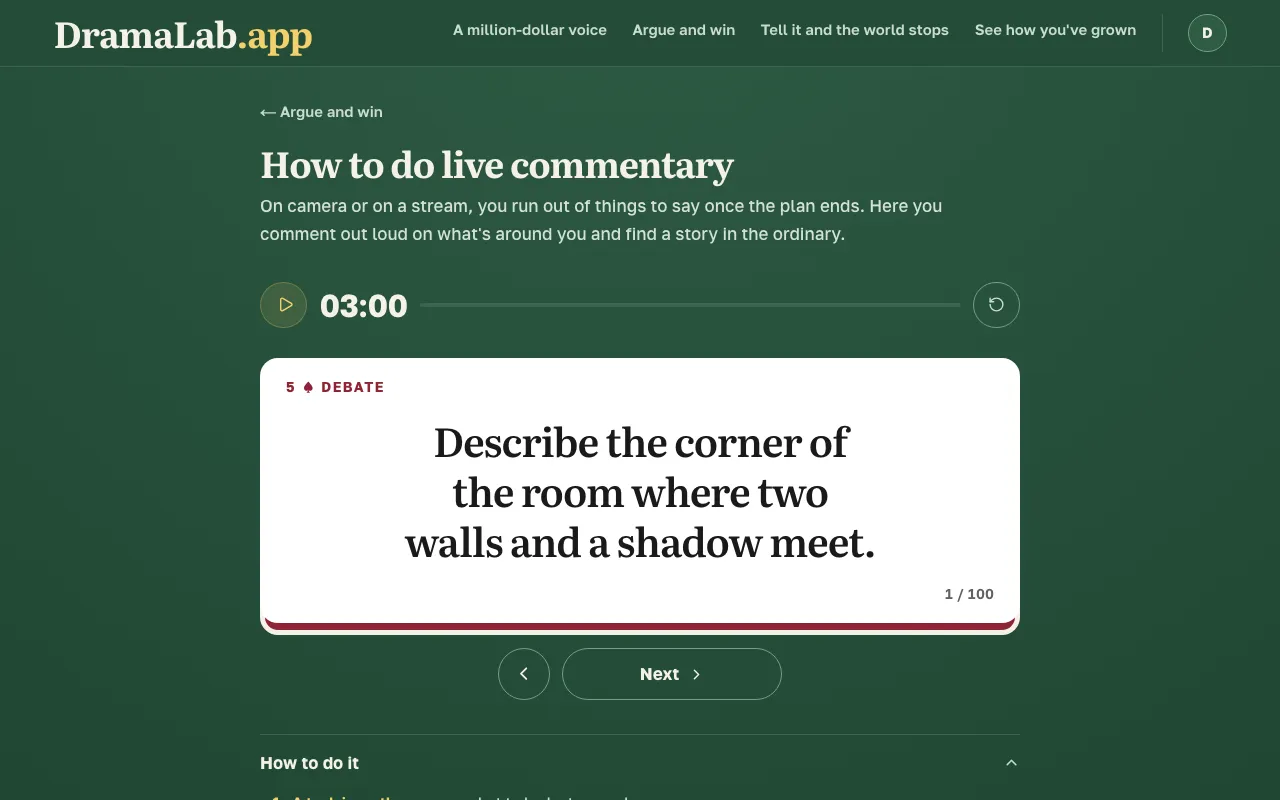
- Live commentary (three minutes). Pick something near you and talk about it out loud, as a host would: what's there, which detail stands out, what story it suggests. DramaLab's “How to do live commentary” exercise gives you a card with what to look at. One card says “Comment on what's happening outside the window right now.” Another says “Find the story in the oldest thing on your desk.”
- Read as if it were your own thoughts (three minutes). Take a short text you haven't seen before and read it aloud as if you were telling a friend about it. Pause before important ideas.
- Record yourself speaking (about four minutes). Set up your phone, pick a topic from your work and talk for one minute from two or three notes. Watch the take, choose one thing to change and record it again.
Commentary is speaking without a script about something in front of you, so you practice finding words as you go. Details make it easier: “a man running for the bus” gives you more to say than “people outside.”
The app doesn't record your voice, so use your phone for the takes. Keep your first take. Once a week, record a new one and compare the two, starting with the point you've been working on.
How can you tell you sound natural?
In short: Listen to a take with your eyes closed. If you can't tell whether you were reading or speaking in your own words, your delivery sounds natural. Then check your first sentence, your eye contact, your voice and the ends of your sentences.
The eyes-closed test comes from DramaLab's “Read aloud fluently: cold reading” exercise, where you read an unfamiliar text as if it were your own thoughts. On each take, also check that:
- the first sentence tells the viewer what the video is about;
- your eyes stay on the lens, and glances at notes go only slightly below it;
- your voice gets louder and softer and stresses important words, as it would with a friend across a table;
- your voice doesn't fade at the end of sentences;
- you would say every sentence the same way to a friend.
If one point fails, fix only that one in the next take. If every word sounds equally flat, choose one important word in each sentence, say it a little more strongly and record again.
If your recorded voice sounds unfamiliar, our guide on how to stop mumbling explains why and how to check that your words are clear.
For your next video, write two or three notes, record one minute and check it against this list. Then change one thing and record it again.
Sources
- Bavelas J. B., Coates L., Johnson T. Listeners as co-narrators. Journal of Personality and Social Psychology, 2000
- Chen M. Leveraging the asymmetric sensitivity of eye contact for videoconference. Proceedings of the SIGCHI Conference on Human Factors in Computing Systems (CHI), 2002
- Gilovich T., Medvec V. H., Savitsky K. The spotlight effect in social judgment: an egocentric bias in estimates of the salience of one's own actions and appearance. Journal of Personality and Social Psychology, 2000
- MacAdam A. Would you say it that way? Tips on writing for your voice. NPR Training, 2015
- Bodarky G. Marking scripts can help you sound more natural on the radio. NPR Training, 2025