How to stop mumbling when you talk: a daily practice plan
DramaLab Editorial ·
When people keep asking you to repeat yourself, record a short video of yourself talking and check five habits. Does your jaw barely open? Do word endings disappear? Do words run together when you speed up? Does your voice fade before the end of a sentence? And is your face turned away from the listener?
In one study, loud speech did not consistently make sentences easier to understand, while clear speech did. This routine focuses on articulation: the way your lips, tongue and jaw shape each sound.
Practice about 10 minutes a day: read aloud with an open mouth and exaggerated word endings, and keep your voice up to the last word. Once a week, make a new recording and compare.
What is mumbling, and why don't you hear it yourself?
In short: In this article, mumbling means speech that people nearby find hard to understand, even when every word was clear in your head. You hear your own voice partly through the bones of your head. A recording leaves that path out, so it lets you hear your speech through the air only.
The words are there, but some of their sounds are hard to hear. A vowel comes out unclear, a final “t” or “d” goes missing or two words sound like one. A listener may ask “Sorry?” or simply guess what you said.
You may only find out when someone asks you to repeat yourself. While you speak, sound reaches your inner ear through the air and through the tissues of your head. Reinfeldt and colleagues measured both paths in 2010. A recording removes the bone path, explains ear, nose and throat doctor Timothy Hullar (Scientific American, 2009), which is why your recorded voice sounds unfamiliar. Use that outside version to check your clarity.
Five habits to check
In short: When people find your speech hard to follow, check five habits. Your jaw barely opens, word endings drop, words run together at speed, your voice fades at the end of a sentence or your face is turned away. You may have one of them or several.
| Habit | What to check on your video | What to practice |
|---|---|---|
| Your jaw barely opens | Does your jaw move when you talk? Are any vowels unclear? | A lip, tongue and jaw warm-up, then reading with your mouth open wider |
| Word endings disappear | Can you hear the last sound of “asked” and “texts”? | Reading aloud with exaggerated endings |
| Words run together when you speed up | In the fast parts, can you tell where one word ends? | Tongue twisters, slowly first, faster only while they stay clean |
| Your voice fades at the end of a sentence | Are the last words as easy to hear as the first? | Reading with the last word as loud as the first |
| Your face is turned away or covered | Is your mouth visible the whole time? | Facing the listener, hands away from your mouth |
Researchers have measured some of these differences by comparing careful speech with everyday talk. In a 1986 analysis, Picheny, Durlach and Braida found that conversational speech often reduced vowels. A final p, t or k often had no audible release, the small puff of air that ends the sound. In clear speech, almost every final consonant was released.
Listeners also use your lips. In a classic 1954 experiment, Sumby and Pollack found that seeing the speaker's face and lips made speech easier to understand. The gain was largest when the noise was loud compared with the speech. So in a noisy room or on a video call, keep your face visible and your hands away from your mouth.
How do you check which habits you have?
In short: Record a two-minute video on your phone: one minute of reading and one minute of talking without a script. The next day, watch it with headphones and mark every word you had to replay or guess. Then check each unclear word against the five habits.
- Prop your phone about an arm's length away, roughly where a listener would be, with your face in the frame.
- Read a paragraph from any book or article aloud for one minute at your normal pace.
- Talk for one more minute without a script: describe your morning or explain what you do at work.
- Watch the video the next day with headphones. Write down every word you had to replay or guess.
- Look at each unclear word. Did you drop its ending, lose volume at the end of the sentence, speak too fast or blur a vowel? Was your mouth visible?
Keep this first recording: you'll compare against it later. DramaLab has exercises with practice texts and a timer. The app doesn't record your voice, so use your phone for the recording check.
What does research say about speaking clearly?
In short: Since the 1980s, researchers have compared clear speech with ordinary conversational speech. In the studies cited here, clear speech was easier to understand. In a 2002 study, it stayed easier to understand at faster rates, and speaking loudly did not consistently help.
Clear speech is the way people talk when they try hard to be understood, for example by someone with hearing loss. In a 1985 study, Picheny, Durlach and Braida recorded three men reading nonsense sentences in both styles. Five listeners with hearing loss then heard the recordings. Their intelligibility scores, the share of speech they understood correctly, were 17 percentage points higher for clear speech on average.
A separate 1994 study by Payton, Uchanski and Braida tested 10 listeners with normal hearing and two with hearing loss. They listened in noise, in reverberation (echo) and in both. The gap grew as noise and echo increased. Among listeners with normal hearing, it averaged 20 percentage points.
“Clear speech is more intelligible than conversational speech for each listener in every environment.”
Payton, Uchanski and Braida, Journal of the Acoustical Society of America, 1994
Clear speech is usually slower, and researchers wanted to know whether slowness itself made the difference. In 2002, Krause and Braida at MIT asked experienced public speakers to read sentences in both styles at slow, normal and quick rates. The speakers also read softly and loudly. Clear speech was the only style with a consistent advantage, and the advantage held at faster rates than earlier studies had shown.
In Picheny and colleagues' 1986 analysis of the recordings, the two styles differed like this:
| Feature | Conversational speech | Clear speech |
|---|---|---|
| Pauses between words | Fewer | More |
| Length of sounds | Shorter | Longer |
| Vowels | Often reduced | Closer to full |
| A final p, t or k | Often no audible release | Released |
| Consonants such as p, t and k | Quieter | Louder |
These studies don't show how much clearer your speech would sound to someone with normal hearing in a quiet office. For a noisy cafe or an echoing meeting room, the 1994 results are more relevant: in that study, the gap grew as noise and echo increased.
A 10-minute daily routine to stop mumbling
In short: Spend about 10 minutes a day on four steps. Warm up your lips, tongue and jaw. Read aloud with exaggerated word endings, then say tongue twisters slowly for clarity. Finish by keeping your voice up to the last word.
The suggested times are a starting point.
- Warm up (two minutes). Open and close your jaw slowly eight times. Let it drop gently, with no clicks. Run your tongue in circles inside your cheeks, six each way. Then alternate a wide smile on “ee” with rounded lips on “oo,” 12 times.
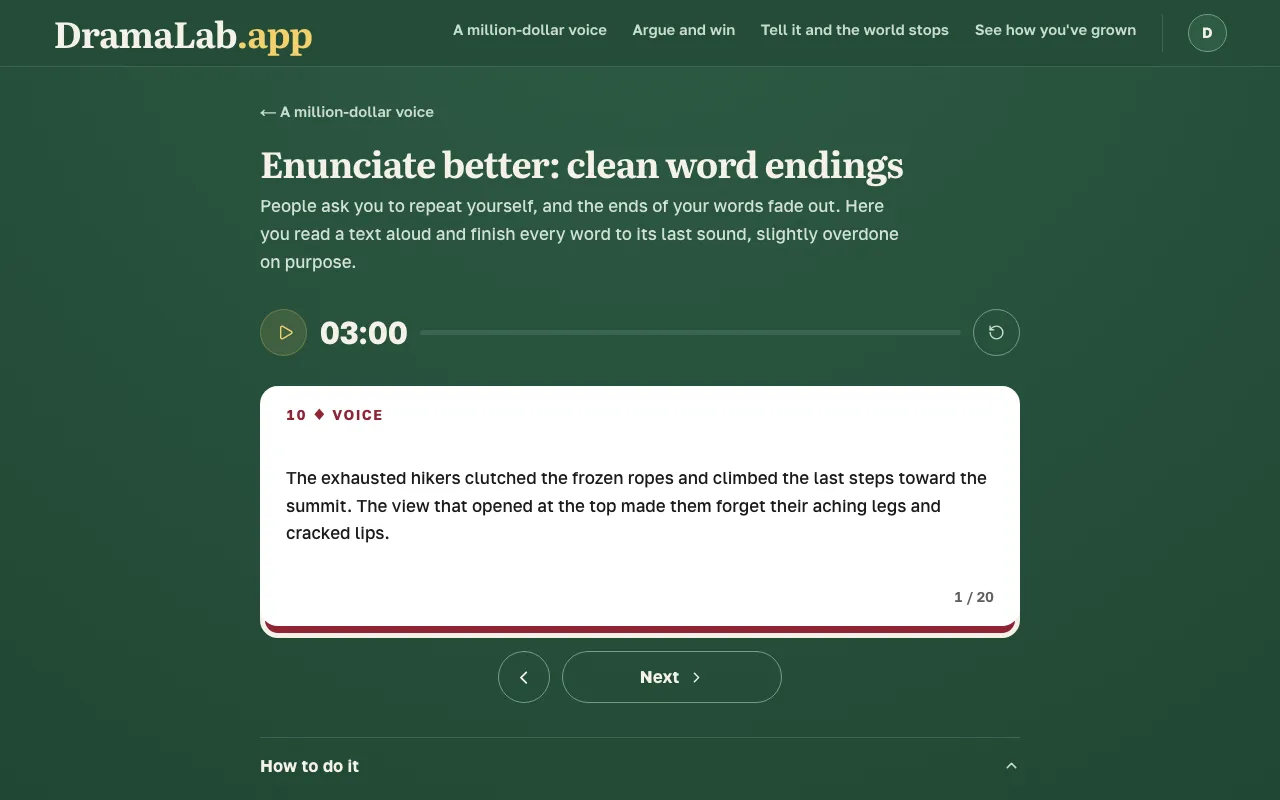
- Word endings (three minutes). Read a short text aloud and finish the last sound of every word, a little louder than feels natural. Listen for the past tense: “-ed” sounds like “t” in “clutched,” like “d” in “climbed” and like “id” in “exhausted.” Try this sentence: “The exhausted hikers clutched the frozen ropes and climbed the last steps toward the summit.”
- Tongue twisters for clarity (two to three minutes). Choose a short one with several consonants together at the ends of words, such as “The hosts left gifts on the guests' desks.” Say it slowly, syllable by syllable, then at normal pace, then louder. Speed up only while every ending stays clean.
- The last word (two minutes). Read sentences aloud and say the last word as loud and clear as the first. Imagine a listener at the other end of the room who needs to hear that last word.
For step three, there are more tongue twisters for word endings and for K, G, T and D. The full tongue twister collection groups them by sound.
Spend more time on the habit you noticed in your recording. If your jaw barely opens, open it a little wider in every reading step. If you drop word endings, add a minute to step two. If you speed up, add it to step three, and if your voice fades, add it to step four.
Won't exaggerated practice make you sound fake?
In short: It may feel overdone at first, and that's deliberate. Exaggeration is for practice time. In conversation, use smaller movements and check on a recording that your word endings are still clear.
At first, reading with exaggerated endings can feel theatrical. DramaLab's “Enunciate better: clean word endings” exercise also asks you to exaggerate the endings during practice.
In conversation, use smaller movements. Then check your next recording of yourself talking without a script. If you sound unnatural, use less effort in conversation and keep the bigger movements for practice.
How to speak clearly in meetings and on calls
In short: Take one habit from practice into real conversations each week. When someone asks you to repeat yourself, say the same words a little slower, with every ending finished. On video calls, keep your face in the frame, lit and uncovered.
When someone asks you to repeat yourself, say the same words again first, a bit slower, with an open mouth and finished endings. If the listener still doesn't understand, ask which part they missed.
- One habit per week. Pick one habit to watch in conversation, for example “finish the last word” this week and “open the jaw” next week.
- Before an important call. Take one minute for the warm-up and read a few lines with clean endings.
- On video. Put the camera at eye level and the light in front of you, and keep your hands away from your mouth. This keeps your lips visible, which helped listeners in noise in Sumby and Pollack's experiment.
- If you speed up. Slow down only as much as you need to finish every word. You can also practice pace on its own, for example by reading to a metronome.
How can you tell it's working?
In short: Record the same one-minute reading once a week and compare it with your first recording. Count the words you had to guess. Watch for two signs: fewer guessed words on the recording and fewer people asking “Sorry?”
For this informal comparison, use the same text, the same phone position and the same room each time. Listen with headphones and check:
- the last sound of each word, such as the “t” in “asked” or the “s” in “texts”;
- the last two or three words of each sentence, compared with the first;
- the parts where you speak faster: can you still hear separate words?
- the vowels: do “bit,” “bet” and “bat” sound different?
If your recordings sound the same after a few weeks, listen to one of your practice sessions. Check that the endings are clearly exaggerated there. If they aren't, make the practice movements bigger.
When is mumbling more than a habit?
In short: Practice is for speech habits. Slurred speech that appears suddenly is an emergency: call 911 or your local emergency number. New trouble talking is a reason to see a doctor, and a speech-language pathologist can assess unclear speech that persists.
DramaLab is a self-practice app, not speech therapy.
Slurred speech means words that run together and sound smeared. Sudden slurred or strange speech, trouble speaking or trouble understanding speech can be signs of a stroke. The CDC says to call 911 right away if you or someone else has any of these symptoms. Outside the US, call your local emergency number.
Slurred or mumbled speech can also be a sign of dysarthria. This is a speech disorder that happens when brain or nerve damage changes the way the speech muscles work. See a doctor right away if talking has become harder recently. If unclear speech persists or gets in the way of daily life, a speech-language pathologist (SLP), a specialist in speech disorders, can assess it.
Sources
- Picheny M. A., Durlach N. I., Braida L. D. Speaking clearly for the hard of hearing I: Intelligibility differences between clear and conversational speech. Journal of Speech and Hearing Research, 1985
- Picheny M. A., Durlach N. I., Braida L. D. Speaking clearly for the hard of hearing II: Acoustic characteristics of clear and conversational speech. Journal of Speech and Hearing Research, 1986
- Payton K. L., Uchanski R. M., Braida L. D. Intelligibility of conversational and clear speech in noise and reverberation for listeners with normal and impaired hearing. Journal of the Acoustical Society of America, 1994
- Krause J. C., Braida L. D. Investigating alternative forms of clear speech: the effects of speaking rate and speaking mode on intelligibility. Journal of the Acoustical Society of America, 2002
- Smiljanić R., Bradlow A. R. Speaking and hearing clearly: talker and listener factors in speaking style changes. Language and Linguistics Compass, 2009
- Sumby W. H., Pollack I. Visual contribution to speech intelligibility in noise. Journal of the Acoustical Society of America, 1954
- Hullar T. E. Why does my voice sound so different when it is recorded and played back? Scientific American, 2009
- Reinfeldt S., Östli P., Håkansson B., Stenfelt S. Hearing one's own voice during phoneme vocalization: transmission by air and bone conduction. Journal of the Acoustical Society of America, 2010
- CDC. Signs and Symptoms of Stroke
- Communication Health Support Association, with the expertise of ASHA. Dysarthria