How to speak slower without sounding robotic
DramaLab Editorial ·
To speak slower without sounding robotic, pause between ideas and say your main points more slowly. Everything else can stay at your usual pace. Start by measuring how fast you talk on a short recording. Then mark your pauses and spend a few minutes a day changing your pace with a metronome.
Why does slow speech sound robotic?
In short: In listening studies, speech that was slowed down evenly made speakers seem less fluent and more passive. Natural speech changes its pace with the context, and in one study listeners noticed when the pace didn't fit. Keep those changes when you slow down.
The obvious way to slow down is to stretch every word. In 1979, researchers Apple, Streeter and Krauss tested something close to it. They stretched recorded answers to interview questions by 30 percent, evenly from start to finish. Listeners rated the slowed speakers as less fluent and less persuasive and described them as more passive.
A 1990 study by Yorkston and colleagues found something similar. When speakers without speech problems slowed down, listeners rated their speech as less natural.
Natural speech speeds up and slows down. Nooteboom and Eefting studied a professional news announcer in 1994 and found that the pace within phrases depended on the context and changed unevenly. When the pace didn't fit the context, listeners noticed, and the speech sounded less natural.
How fast do you talk, in words per minute?
In short: Record two minutes of yourself speaking, count the words and divide by the number of minutes. That is your pace in words per minute. Averages in the table below range from about 155 for audiobooks to 236 for phone calls counted without silences. So compare yourself with yourself and listen for where you speed up.
- Record yourself on your phone for two minutes. Describe a recent meeting, a movie or your plans for the week, the way you would to a colleague.
- Get a written transcript of the recording, or type out the first minute yourself, and count the words.
- Divide the number of words by the number of minutes you transcribed. This is your pace in words per minute.
- Listen again and mark where you sped up. Check the first sentence, lists, the parts you know by heart and the ending.
The figure of 140 to 160 words per minute appears in many articles, usually without a study behind it. Measured rates depend on the kind of speech and on how the words and the time are counted:
| Kind of speech | Words per minute | Where the number comes from |
|---|---|---|
| Adults reading aloud | 183 | Average of 77 studies (Brysbaert, 2019) |
| Audiobook narration | 155 | ACX, Audible's platform for making audiobooks |
| Phone calls in English, counted by speaking turns | 164 | Yuan and colleagues, 2006 |
| The same calls, counted without silences | 236 | Yuan and colleagues, 2006 |
ACX says most narrators read about 9,300 words per hour of finished audio, which works out to about 155 a minute. In the phone study, the lower number uses the time of each person's turns, and the higher one leaves out the silences. Counted over the whole length of each call, the average was 196. In the same paper, calls between strangers were about 10 percent slower than calls with friends and family.
Measure your pace again after a few weeks of practice.
For ready-made practice texts, try the DramaLab speech training app. It has short texts for reading aloud and a metronome that sets the pace for you.
Where should you pause, and for how long?
In short: Pause at the ends of phrases and sentences. Pause for about half a second at a comma, about a second at a period and a little longer after your main point. Listeners hear speech with longer pauses as slower even when the words keep the same speed.
In a 2022 study, Liu and colleagues changed only the pauses at commas and periods in recordings of English speech. The words stayed exactly the same. As the pauses got longer, listeners rated the speech as slower. The listeners were native English speakers and native speakers of Chinese and Japanese.
Their study also tested how long a pause should last. Speech sounded most natural with pauses of about 0.6 seconds inside a sentence and 0.6 or 1.2 seconds between sentences. Much longer pauses did not sound more natural. For non-native speakers of English, the authors suggest pauses of about 0.6 seconds as a training target.
In the original recordings of that study, comma pauses averaged from about half a second to three quarters of a second. Period pauses averaged about 1.4 seconds. The rule in this article rounds these numbers down: about half a second at a comma and about a second at a period. If one fixed length is easier for you, use 0.6 seconds for every pause.
Where you pause matters too. In a 2023 experiment, O'Leary and colleagues sped up recorded stories. They restored the lost time by adding pauses at natural breaks within and between sentences. Young adults with normal hearing then remembered almost as much as at normal speed. In an earlier study from the same lab at Brandeis University (Wingfield and colleagues, 1999), pauses at random points helped little or not at all.
To mark pauses in your notes, use one slash for a short pause and two slashes for a longer one:
“The new schedule starts on Monday. // For most of you, / nothing changes. // If you work late shifts, / please read the second page.”
Read the marked text aloud and take a quiet breath through your nose in the longer pauses. If a pause of one second feels too long while you speak, record yourself reading the text and listen before you shorten it.
Which parts should you say more slowly?
In short: Slow down on your main point and on anything new to your listener. Say numbers and names more slowly too. Keep the rest at your usual pace. Speech coaches recommend this varied pace, and a 2024 study on speaking speed calls it a question for future research.
| Say more slowly | Keep your usual pace |
|---|---|
| Your main point and your conclusion | Background the listener already knows |
| Numbers, names, dates and addresses | Examples and stories |
| A new term or an unfamiliar idea | Transitions such as “next” or “for example” |
| The first sentence of a talk or an answer | Points you are repeating |
Speech coach Katie Schwartz gives a benchmark in Fast Company: speak slowly enough that a listener could write down a phone number you recite.
Don't slow everything down. Guyer and colleagues ran six studies with nearly 4,000 participants and changed only the speed of recorded persuasive messages. Moving from very slow to normal speed made the speaker seem more confident and made listeners think more about the message. Above the speaker's normal speed, listeners felt they understood less.
The same team notes that coaches advise speaking slower on key points and faster on less important ones. The researchers call it a question for future research. Before your next talk, mark the parts from the left column of the table in your notes.
How do you practice your pace with a metronome?
In short: Read a short text aloud one word per beat while a metronome goes from 60 to 90 to 120 beats per minute and back down. It takes about four minutes. Then read the same text at your normal pace, with a pause at the end of each sentence.
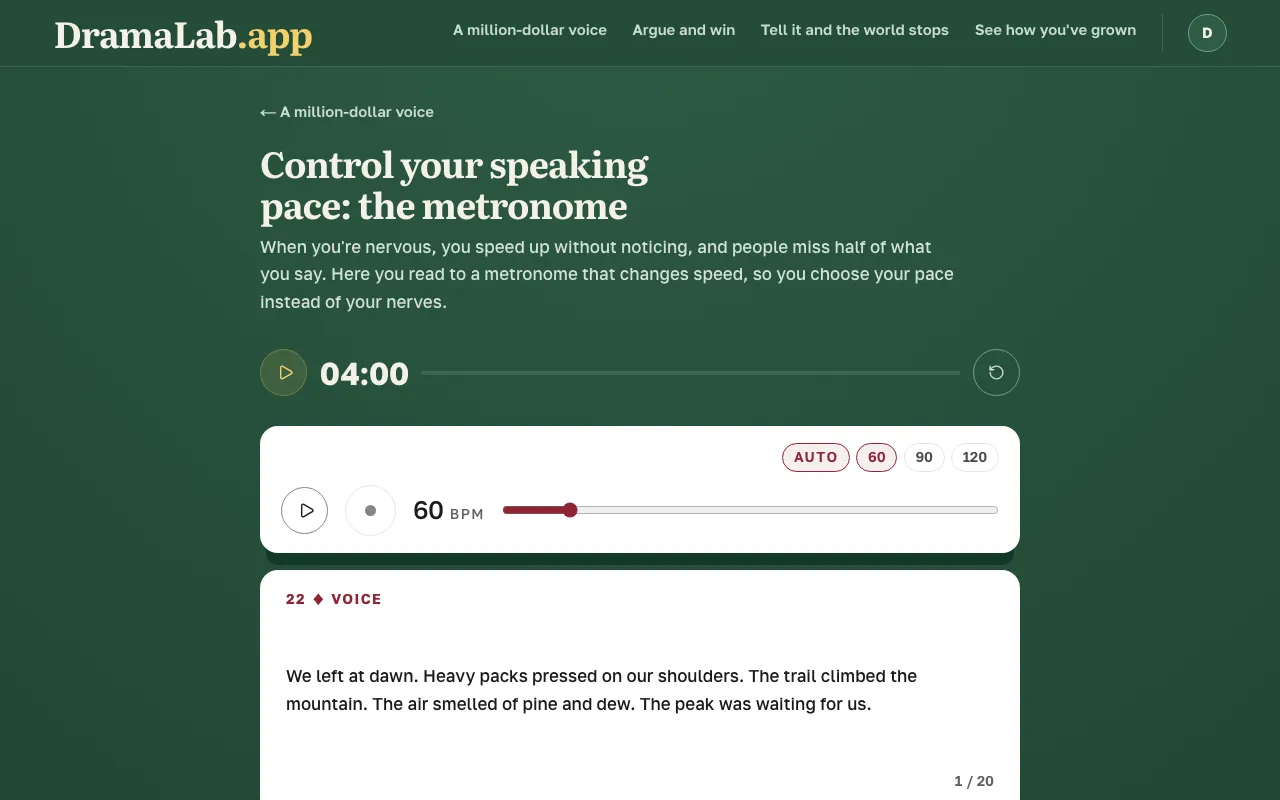
In DramaLab's “Control your speaking pace: the metronome” exercise, the metronome changes speed on its own:
- Open a short text of five or six simple sentences and start the metronome at 60 beats per minute.
- Read aloud one word per beat.
- When the metronome moves up to 90, keep one word per beat.
- At 120, keep going and make sure every word stays clear.
- Let the metronome come back down to 90 and then to 60, and slow down with it.
Important. One word per beat is a drill for control. At 90 beats per minute, that's 90 words per minute, much slower than ordinary conversation, so use this pace only in practice. The drill trains you to notice your pace and change it on purpose.
After the drill, read the same text once more at your normal pace and pause at the end of each sentence. Here is one of the exercise texts:
“I decided to hang a shelf. I measured twice. I drilled three neat holes. The shelf is level and firm. Just on the wrong wall.”
If the words blur at 120, work on clarity first. Our guide on how to stop mumbling and the tongue twister pages help with that.
DramaLab doesn't record your voice. Record the drill text on your phone today, then record it again once a week and compare it with that first recording.
How to speak slower in presentations, interviews and calls
In short: Plan your pauses before you speak. Mark them in your presentation notes and cut what doesn't fit into your time slot. Before you answer an interview question, take a breath. On a call, speak a little slower and leave room for the other person.
You may notice that you speed up when you're nervous. A 2025 review of studies in the journal PLOS One reports mixed results: one study found faster speech under stress, and three others found no change. Either way, mark your pauses before you start so you don't have to judge your pace in the middle of a sentence.
- Presentation. Mark pauses in your notes with slashes, especially after each main point. If you have more material than time, cut the less important parts. Joel Schwartzberg, writing in Toastmasters Magazine, explains: “anything you rush will not be retained.”
- Interview. Take one breath before you answer. Say your main point in the first sentence, then give a reason and an example. Our guide on how to express your thoughts clearly shows this structure.
- Video call or phone call. Two researchers, Cascio Rizzo and Berger, posted a draft study on customer service calls in 2023. In it, agents who spoke more slowly seemed more empathetic, and customers were more satisfied. In a Knowledge at Wharton article about the study, the researchers note that service agents shouldn't speak extremely slowly. Speak a little slower than you would with a friend, and pause at the end of each thought to let the other person respond.
When should you see a specialist about talking too fast?
In short: If your speech often sounds rushed or unclear even when you try to slow down, see a speech-language pathologist (SLP). This specialist diagnoses and treats speech disorders. Many restarts and syllables that run together can be signs of cluttering. Like stuttering, it is a fluency disorder, but the two are not the same. DramaLab is a self-practice app, not speech therapy.
The American Speech-Language-Hearing Association (ASHA) lists the signs of cluttering. They include speech that sounds too fast or irregular, along with many restarts and fillers such as “um.” Pauses fall in unexpected places, and syllables run together. ASHA also notes that a person with cluttering doesn't always speak faster than average, but listeners hear the speech as fast.
An SLP can tell whether this is cluttering. The Stuttering Foundation advises seeing one for a diagnosis. If you also stutter, talk to an SLP before you rely on pace exercises.
How do you know you've slowed down?
In short: Compare two recordings of the same text, made a few weeks apart. In the newer one, listen for clear pauses at the ends of sentences, a slower main point and words that don't sound stretched. Also notice whether people still ask you to repeat yourself.
Listen to the newer recording and check that:
- there is a clear pause at the end of each sentence;
- your main point is slower than the rest;
- no word sounds stretched;
- lists and numbers are easy to follow;
- your pace in words per minute is lower than when you started.
If one check fails, focus your practice on that for a week and then record again.
Start today: record yourself for two minutes and count the words. Then mark the pauses in the notes for your next presentation.
Sources
- Apple W., Streeter L. A., Krauss R. M. Effects of pitch and speech rate on personal attributions. Journal of Personality and Social Psychology, 1979
- Yorkston K. M., Hammen V. L., Beukelman D. R., Traynor C. D. The effect of rate control on the intelligibility and naturalness of dysarthric speech. Journal of Speech and Hearing Disorders, 1990
- Nooteboom S. G., Eefting W. Evidence for the adaptive nature of speech on the phrase level and below. Phonetica, 1994
- Brysbaert M. How many words do we read per minute? A review and meta-analysis of reading rate. Journal of Memory and Language, 2019
- ACX. How long will my narrated audiobook be?
- Yuan J., Liberman M., Cieri C. Towards an integrated understanding of speaking rate in conversation. Interspeech, 2006
- Liu S., Nakajima Y., Chen L. et al. How pause duration influences impressions of English speech: comparison between native and non-native speakers. Frontiers in Psychology, 2022
- O'Leary R. M., Neukam J., Hansen T. A. et al. Strategic pauses relieve listeners from the effort of listening to fast speech: data limited and resource limited processes in narrative recall by adult users of cochlear implants. Trends in Hearing, 2023
- Wingfield A., Tun P. A., Koh C. K., Rosen M. J. Regaining lost time: adult aging and the effect of time restoration on recall of time-compressed speech. Psychology and Aging, 1999
- Moran G. 6 simple ways to improve the way you speak. Fast Company, 2014
- Guyer J. J., Vaughan-Johnston T. I., Fabrigar L. R. et al. Vocal speed and processing of persuasive messages: curvilinear processing effects. Journal of Nonverbal Behavior, 2024
- Schewski L., Magimai Doss M., Beldi G., Keller S. Measuring negative emotions and stress through acoustic correlates in speech: a systematic review. PLOS One, 2025
- Schwartzberg J. How to quit talking quickly. Toastmasters Magazine, 2021
- Cascio Rizzo G. L., Berger J. The power of speaking slower. SSRN working paper, 2023
- Basiouny A. How speaking slower influences consumer behavior. Knowledge at Wharton, 2025
- American Speech-Language-Hearing Association. Stuttering, cluttering, and fluency. ASHA Practice Portal
- St. Louis K. O., Scott K. Cluttering. The Stuttering Foundation