How to stop saying “um” and “like”
DramaLab Editorial ·
To stop saying “um” and “like,” count them on a recording first and treat them as two separate habits. “Um” is most likely at the start of a phrase. At that point, close your lips, take a short pause and begin with the first word. Replace filler “like” with the word you mean: “about” before a number, “said” before a quote. Aim for fewer and shorter fillers: several a minute is normal in unprepared speech.
Why do people say “um” and “like”?
In short: “Um” and “uh” signal that you need a moment to decide what to say next. “Like,” “you know” and “I mean” are a different habit, and a study of 263 transcripts put them in a separate group from “um” and “uh.” Fillers can increase when you focus on your own speech, so start practicing where nothing is at stake.
Herbert Clark and Jean Fox Tree studied recordings of spoken English. They concluded that speakers use “uh” to announce a short delay and “um” to announce a longer one. In their data, a delay followed “um” 61 percent of the time and “uh” 29 percent of the time. Fillers were most likely at the start of a phrase, before its first word: 43 per 1,000 possible places, compared with 13 later in the phrase.
“Like” works differently. Researchers Laserna, Seih and Pennebaker analyzed 263 transcripts of everyday speech. “Um” and “uh” formed one group of fillers, and “like,” “you know” and “I mean” formed another.
In everyday English, “like” can also carry meaning. Linguist Valerie Fridland explains that “he's like 12 years old” is a way of saying “he's about 12.”
Anxiety can add “ums” as well. Christenfeld and Creager concluded that this may happen when anxiety makes speakers pay attention to their own speech. That is a good reason to practice alone first, where nobody is judging you.
How many filler words are normal?
In short: In studies of unprepared speech, several fillers per minute is typical: lecturers in an informal interview averaged about five. Count yours on a recording of two to three minutes, then compare later recordings with that first count. The goal is fewer and shorter fillers, since even fluent speakers use some.
- Record yourself answering a question you haven't prepared for, such as “What did you work on this week?” Talk for two to three minutes.
- Play it back and count every “um,” “uh” and “like.” Keep separate counts, because they need different fixes.
- Divide each count by the number of minutes and write down each count and its rate per minute.
- Note where the fillers fall: at the start of a sentence, in the middle or right before an answer.
The recording matters because impressions are unreliable. In a German study by Niebuhr and Fischer, listeners heard excerpts of about a minute from longer talks, without counting. Their estimates could be off by as many as six to eight fillers. Toastmasters clubs even have a role for counting them, the Ah-Counter. Its purpose is “to note any overused words or filler sounds used as a crutch by anyone who speaks during the meeting.”
Here is what researchers counted in real speech:
| Situation | Fillers per minute | Source |
|---|---|---|
| Lectures in the natural sciences | 1.39 | Schachter and colleagues, 1991 |
| Lectures in the humanities | 4.85 | Schachter and colleagues, 1991 |
| The same lecturers in an informal interview | 5 | Schachter and colleagues, 1991 |
| Business presentations in German | 6.33 | Niebuhr and Fischer, 2019 |
Stanley Schachter and colleagues recorded lectures at Columbia University. Lecturers in the humanities said “uh” far more often than lecturers in the natural sciences. In an interview on the same topic, lecturers from every field averaged about five a minute. The authors linked fillers to the number of word choices a speaker faces.
In the German study, 68 managers used from 1 to 13 fillers per minute. In conversations recorded by Bortfeld and colleagues, fillers made up about 2.6 of every 100 words.
To get a first count, you need something to talk about: the DramaLab speech training app has ready topics and short texts for reading aloud.
Is a short pause better than “um”?
In short: Speech coaches recommend a short pause instead of “um,” but listening experiments by Christenfeld and by Brennan and Williams show its limits. Silence in place of a speaker's “ums” sounded worse than the “ums” themselves. Before an answer, a long delay makes you seem less sure. So keep the pause short and put it before the first word of a sentence.
Joel Schwartzberg writes in Toastmasters Magazine: “Most public-speaking experts agree that the best replacement for a crutch word is a deliberate pause.” Nicholas Christenfeld played listeners one recording in three versions. The first kept the speaker's “ums,” the second had silence in their place and the third had the “ums” cut out with no gap left. Listeners rated the speaker best in the version with neither “ums” nor silences, and the “ums” made a better impression than the silences.
Jean Fox Tree studied how listeners judge replies. When speakers said “um” or paused before replying, listeners thought the speakers had more trouble putting the answer into words and were less honest. Brennan and Williams compared delays: answers given after one second sounded more confident than answers given after five seconds. A filler before an answer made the speaker seem less sure than silence did.
In lab experiments by Corley and colleagues, fillers helped listeners: words that came right after a filler were remembered better. In a study by Fraundorf and Watson, fillers helped recall, while coughs of the same length hurt it.
In Niebuhr and Fischer's study, speakers with longer fillers sounded less competent, but the authors don't recommend trying to cut fillers out completely. Lisa B. Marshall puts it the same way in Toastmasters Magazine: “Your goal should be reduction, not elimination.”
How do you replace “um” with a pause?
In short: Find where your “ums” fall, often at the start of a sentence or right before an answer. At that moment, close your lips, take a quiet breath and start with the first word. Small training studies used three steps: describe your filler, spot it on a recording, then catch it while you speak.
- Name your filler exactly: “um,” “uh,” “so” or another word you use the same way. Write down where it usually appears.
- Find it on your recording. Play it back once and listen only for that filler. Mark each one.
- Notice it while you speak, as the “um” starts.
- Close your lips instead, breathe in quietly through your nose and say the first word of the sentence.
- Know the first sentence of each point before you speak, since fillers are most likely right before a phrase begins.
The first three steps follow awareness training, a method tested in a series of small studies in the Journal of Applied Behavior Analysis. In studies by Montes and colleagues and by Ortiz and colleagues, people first spotted their fillers on video and then while speaking. In a study by Mancuso and Miltenberger, all six participants used fewer fillers right after training that combined awareness training with a replacement behavior.
Pawlik and Perrin taught four participants to make a silent pause instead of a filler. All four stumbled less in their speeches afterward, but only one of them used the pause to a noticeable degree. Steps four and five are our own advice for making the pause easier.
Watch for “so” or “right” at the start of every sentence: they can take the place of “um.” If they do, count them as fillers too.
How do you stop saying “like”?
In short: Keep “like” when it means “similar to” or “such as.” When it only fills a gap, replace it with the word you mean (“about” before a number, “said” before a quote) or drop it. Then count your filler “likes” on a recording, separately from your “ums.”
| Instead of | Say |
|---|---|
| It took like an hour | It took about an hour |
| She was like, “We can't ship this.” | She said, “We can't ship this.” |
| It's like really important | It's really important |
| Like, we need to decide today | We need to decide today |
In a listening test by Jennifer Dailey-O'Cain, speakers who used “like” seemed younger. They were also rated more positively on some traits but less positively on traits linked to status. With friends, “like” is ordinary English. In an interview or a presentation, the precise word works better.
Use “said” when you repeat what someone actually said. If you are describing a reaction or a thought, name it: “She was surprised” or “I thought, that can't be right.”
Which exercise trains the pauses that replace “um”?
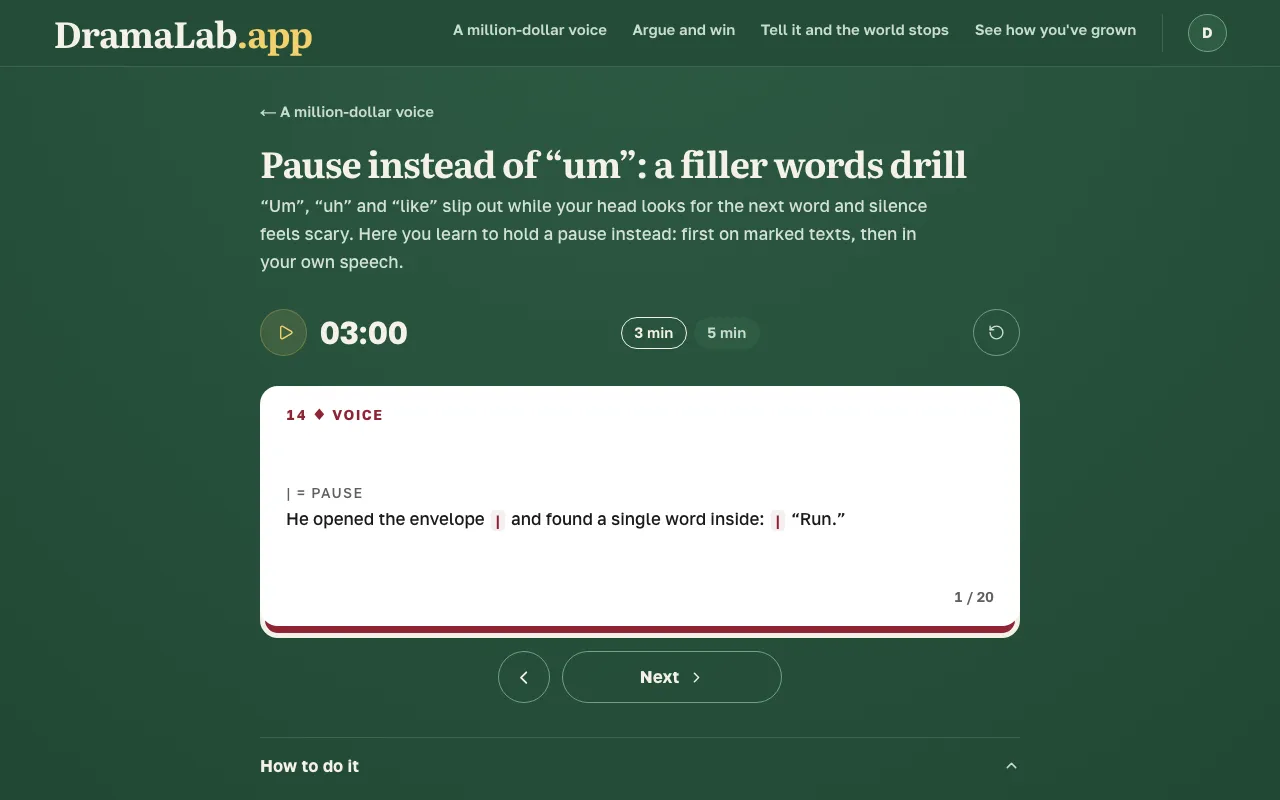
In short: DramaLab's “Pause instead of ‘um’: a filler words drill” exercise trains you to stay silent on purpose. You read a short text and pause at marked places for one to three seconds, in three rounds. It takes three minutes. Then talk about any topic for a minute and start each sentence after a short pause.
The exercise has three rounds:
- Read the text and pause for exactly two seconds at every mark. Count to two silently.
- Read it again and vary the pauses from one to three seconds, depending on how important the next word is.
- Drop half of the pauses and keep only the ones that add emphasis.
The texts are short stories with marks where silence adds meaning or tension. Here is one, with each mark shown as a slash: “He opened the envelope / and found a single word inside: / ‘Run.’”
Important. In this drill, pauses of two or three seconds are deliberate. Before an answer in a real conversation, about a second is plenty.
After the drill, take any topic and talk about it for a minute, starting each sentence after a short pause. Record that minute on your phone and count the fillers the same way as in your first count.
How do you stop saying “um” in an interview or a presentation?
In short: Fillers are most likely at the start of a phrase, so the first sentence of an answer or of a new point needs the most care. Prepare those sentences and replies to the questions you expect. On a call, if you need more than a second to think, say so.
- Before an answer. Prepare the first sentence for likely questions. When the question comes, close your lips, pause briefly and start with that sentence. Keep the pause short: a long one makes you seem less sure. To build the rest of the answer, see how to express your thoughts clearly.
- Between points of a talk. Write the first sentence of each new point in your notes and mark a pause before it. How long to hold a pause is covered in how to speak slower without sounding robotic.
- Questions after a talk. Prepare answers to the three questions most likely to come up. This is the part of a talk you can prepare for least.
- On a call. Keep any pause to about a second. If you need longer, say so: “Let me think about that for a moment.”
Can filler words be a sign of stuttering?
In short: On their own, “um” and “uh” are typical disfluencies: moments when speech is not smooth, which everyone has. If you also repeat sounds or syllables, stretch sounds, get stuck on words or feel tension when you speak, see a speech-language pathologist (SLP). This specialist diagnoses and treats stuttering. The same applies if you add “um” to get around a word you expect to stutter on. DramaLab is a self-practice app, not speech therapy.
A public guide on stuttering written with the American Speech-Language-Hearing Association (ASHA) lists saying “uh” or “you know” among typical disfluencies. The signs of stuttering are different. You may repeat sounds or syllables, stretch sounds or stop before a word and find you can't get it out (a block). Stuttering may also bring tension and negative feelings about talking.
ASHA also lists fillers such as “um” and “like” among avoidance behaviors in stuttering: things you do to hide a stutter before it happens. If that sounds familiar, see an SLP before you use the drills in this article.
If none of this applies, go back to your first count. Find the spot where most of your “ums” fall, such as the first word of an answer, and practice the pause there this week.
Sources
- Clark H. H., Fox Tree J. E. Using uh and um in spontaneous speaking. Cognition, 2002
- Laserna C. M., Seih Y.-T., Pennebaker J. W. Um... who like says you know: filler word use as a function of age, gender, and personality. Journal of Language and Social Psychology, 2014
- Stanford Graduate School of Business. “Um, like, so”: how filler words can be effective in communication. Think Fast, Talk Smart podcast with Valerie Fridland, 2023
- Christenfeld N., Creager B. Anxiety, alcohol, aphasia, and ums. Journal of Personality and Social Psychology, 1996
- Niebuhr O., Fischer K. Do not hesitate! Unless you do it shortly or nasally: how the phonetics of filled pauses determine their subjective frequency and perceived speaker performance. Interspeech, 2019
- Toastmasters International. Ah-Counter
- Schachter S., Christenfeld N., Ravina B., Bilous F. Speech disfluency and the structure of knowledge. Journal of Personality and Social Psychology, 1991
- Bortfeld H., Leon S. D., Bloom J. E., Schober M. F., Brennan S. E. Disfluency rates in conversation: effects of age, relationship, topic, role, and gender. Language and Speech, 2001
- Schwartzberg J. Drop those crutches. Toastmasters Magazine, 2019
- Christenfeld N. Does it hurt to say um?. Journal of Nonverbal Behavior, 1995
- Fox Tree J. E. Interpreting pauses and ums at turn exchanges. Discourse Processes, 2002
- Brennan S. E., Williams M. The feeling of another's knowing: prosody and filled pauses as cues to listeners about the metacognitive states of speakers. Journal of Memory and Language, 1995
- Corley M., MacGregor L. J., Donaldson D. I. It's the way that you, er, say it: hesitations in speech affect language comprehension. Cognition, 2007
- Fraundorf S. H., Watson D. G. The disfluent discourse: effects of filled pauses on recall. Journal of Memory and Language, 2011
- Marshall L. B. Um, how do I stop, ya know, using um and ah?. Toastmasters Magazine, 2017
- Montes C. C., Heinicke M. R., Guendulain M. A., Morales E. A component analysis of awareness training for reducing speech disfluencies. Journal of Applied Behavior Analysis, 2021
- Ortiz S. M., Deshais M. A., Miltenberger R. G., Reeve K. F. Decreasing nervous habits during public speaking: a component analysis of awareness training. Journal of Applied Behavior Analysis, 2022
- Mancuso C., Miltenberger R. G. Using habit reversal to decrease filled pauses in public speaking. Journal of Applied Behavior Analysis, 2016
- Pawlik B., Perrin C. J. Reducing speech disfluencies during public speaking using brief habit reversal. Journal of Applied Behavior Analysis, 2020
- Dailey-O'Cain J. The sociolinguistic distribution of and attitudes toward focuser like and quotative like. Journal of Sociolinguistics, 2000
- Communication Health Support Association (with ASHA). Stuttering and cluttering
- American Speech-Language-Hearing Association. Stuttering, cluttering, and fluency. ASHA Practice Portal